Indy 500 Goes Down To The Wire 1982

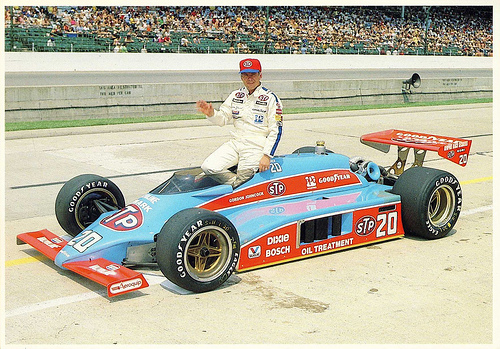
The top video is a great story featuring interviews with Gordon Johncock and Rick Mears about their battle for the 1982 Indy 500.
The 1982 race was memorable for several reasons. Firstly, in practice Gordon Smiley had one of the most horrific accidents ever recorded when he tried to save a slide and ended up crashing head on into the wall, killing himself instantly.
Then on race day as the field was making its way around to the start line to get the race underway, Kevin Cogan, starting from the middle of the front row, jinked right into A J Foyt. The subsequent crash took Foyt and also Mario Andretti before the race had even begun. Wiping out two legends of American motor sport was not a good career manouver for Mr Cogan. Foyt managed to make the restart but Andretti was forced to watch the race along with four other drivers. The second video shows the startline crash.
Once the race got going Foyt stormed into the lead, but was soon overtaken by Mears who appeared to have the fastest machine and was looking good, but Johncock was right with him.
With less than 20 laps to go, Gordon Johncock led Rick Mears, but both drivers needed to make one final pit stop to make it to the finish.
With 18 laps to go Mears was in the pits. The car of Herm Johnson slowed in front, and Mears bumped into his back wheel. The incident cost Mears a few precious seconds. In his pit box, Mears Penske crew decided to fill his car full with 40 gallons of fuel, more than enough needed to make it to the finish.
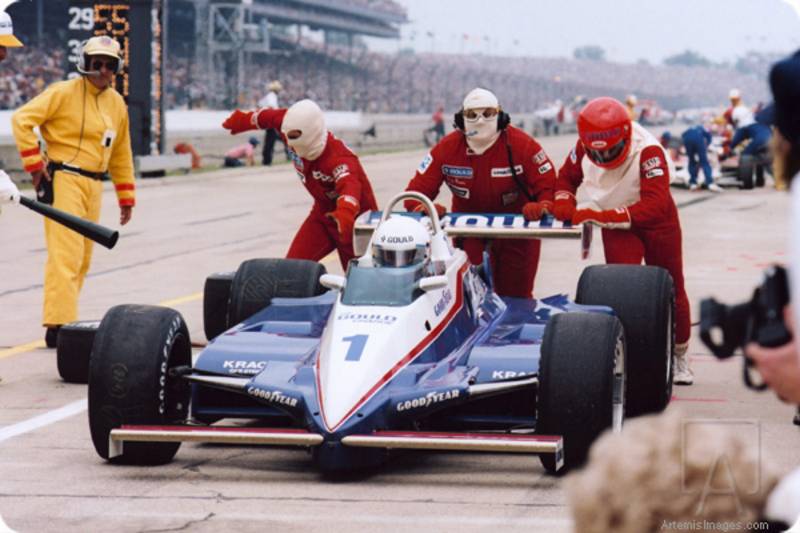
Two laps later, Johncock ducked into the pits. The Patrick Racing crew calculated the exact amount of fuel needed to make it to the finish. When enough fuel has flowed into the car, a pit crew member tapped the fuel man on the back with a stick, and he disengaged. This allowed Johncock to pull away with a stop a couple of seconds quicker than Mears.
Back on the track, Johncock held a lead of more than eleven seconds. It looked as though he was cruising to his second Indy victory. However, his car was starting to puch or understeer badly due to the light fuel load and Mears began to reel him in.
Meanwhile, Mears’ fully-fueled car was heavier, and handling much better. He started closing in, more than 1 second per lap. Johncock started driving very low in the turns, trying to compensate for the understeer.
It became clear that Mears was dramatically closing in on the lead, but it was going to be close!
Mears closed to under 3 seconds with 3 laps to go. With two laps to go, the margin was less than 1 second. In turn three, Johncock’s had a big moment and almost understeered into the wall allowing Mears to close right in.
With one lap to go, Mears pulled alongside on the main straight. The cars took the white flag side-by-side, but Johncock refused to give up the lead and gave Mears a good block into the first turn, and stayed ahead. It was enough for Mears to lose considerable momentum, but he began to reel Johncock back in down the backstretch. As they exited turn four, Mears tried to slipstream past Johncock for the win. However it was not enough.
Johncock held on for a memorable victory, winning by 0.16 seconds, the closest-ever in Indy 500 history at the point in time.
