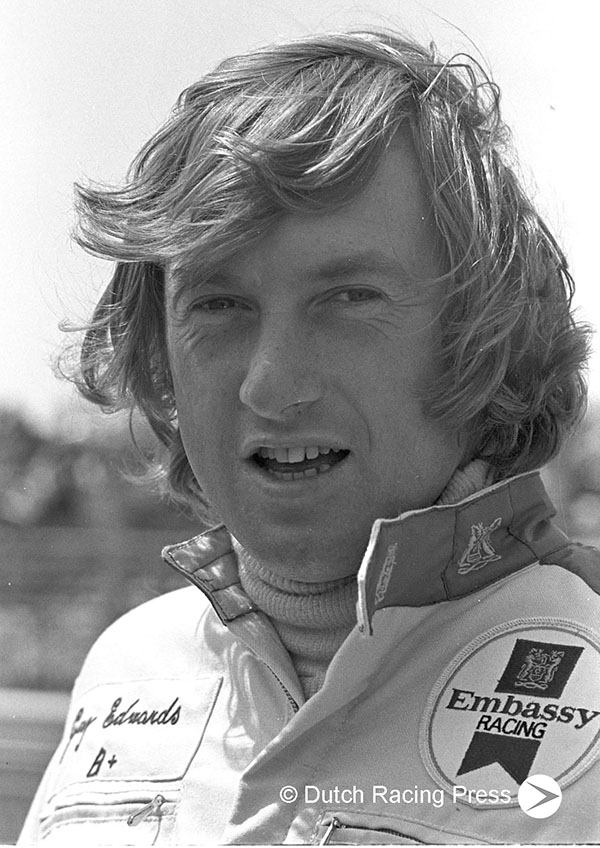
Heroes From The Past: Guy Edwards QGM

By Marcel Hundscheid / Speed-O-Graphica
Images by Dutch Racing Press/Winau Berkhof
In this episode of *Heroes from the Past*, we look back at the racing career of Guy Edwards, who recently passed away suddenly.
Edwards was one of the most successful drivers in both the British Aurora Formula 1 Championship and the European Formula 5000 championships. Edwards was born and raised in the area around Liverpool. Notably, he initially had no interest in motor racing whatsoever; however, this changed quickly when he visited Oulton Park with friends in 1959. He earned an honours degree in Geography and Psychology from Durham University but immediately headed to Brands Hatch afterwards with the aim of becoming a professional racing driver.
At the time, Edwards worked as a freelance salesperson for tableware and central heating systems. He took his first steps in motorsport driving a Ford Anglia and later a Mini Cooper S. A trip to Karlskoga, Sweden, secured him his first sponsorship deal; in exchange for promoting Tor Line Ferries on his Mini, the shipping company provided him with a cabin for the crossing. His race in Karlskoga went well—he won his class—even though his Mini’s engine gave up the ghost the moment he crossed the finish line.
Guy managed to secure the backing of his employer, Renowned Heating, to compete in the Formula 3 championship for 1-liter engines driving a Lola T62. However, this adventure came to an end when Edwards decided to resign. Edwards subsequently secured sponsorship from Tor Line Ferries, enabling him to purchase a new Chevron-BMW B8. He used this car to compete in sports car races across Northern Europe during the 1969 season. In 1970, Guy could no longer count on financial support from Tor Line. However, the Briton had secured a deal with Philips Autoradio that allowed him to compete in sports car races across mainland Europe and in England driving an Astra RNR2. Although the Astra was far from reliable, Edwards managed to win the Benelux Trophy at Zandvoort.
This strong result, combined with the relationship Edwards had built with Philips, enabled him to acquire a new Lola T212 for the 1971 season. It was a world of difference compared to the Astra, earning him victories at Nogaro and Crystal Palace. He was keen to remain active in the world of single-seaters alongside sports car racing. Edwards subsequently entered the British International Championship for F5000 cars, competing at Brands Hatch in a McLaren M10B owned by John Butterworth.
That race—in which the F5000s featured as a support event—was overshadowed by tragedy following the death of Jo Siffert during the British Grand Prix at Brands Hatch. Edwards competed in 1972 driving a Lola T290, backed by Barclays International. He claimed victory at Snetterton during a round of the RAC British Sportscar Championship. In Europe, a number of second-place finishes in the European 2-Litre Sportscar Championship—at Silverstone and Vallelunga—saw him finish fourth in the championship standings.
Although the McLaren M10B he campaigned in Formula 5000 was outdated, he still managed to achieve good results. Edwards could also count on the support of Barclays International in 1973; he drove a Lola T332 in Formula 5000 and used a Lola T292 for sports car racing. By this time, Edwards had also established a respectable reputation in the fiercely contested European 2-Litre Sports Car Championship. He finished fourth in the championship in 1972.
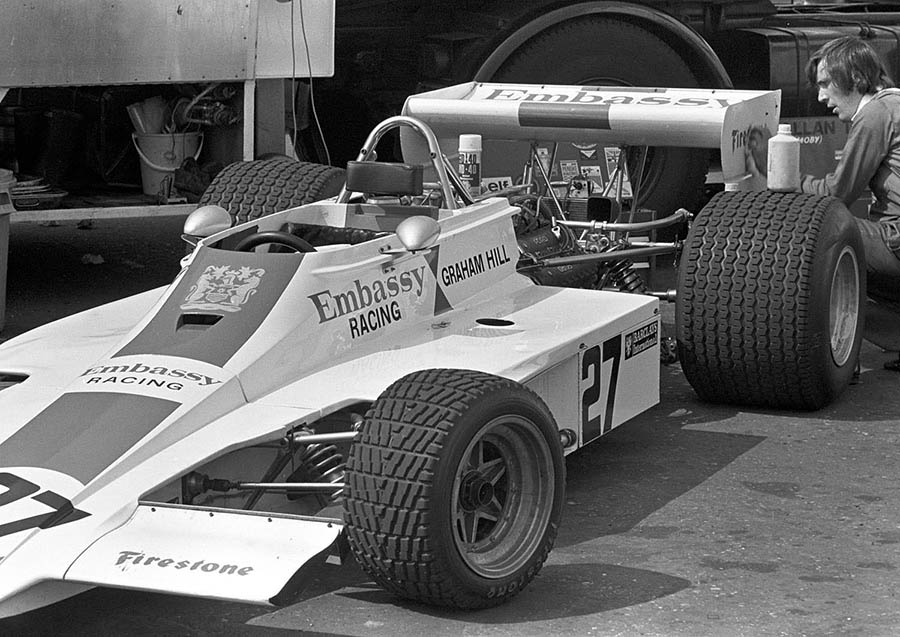
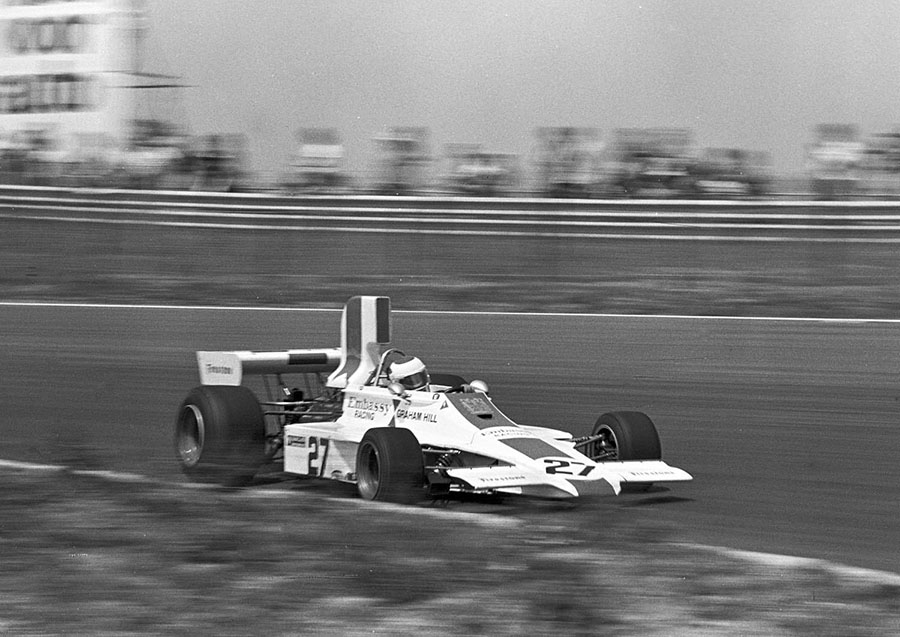
A year later, a camshaft failure during the season finale at Montjuïc cost him the title; Chris Craft became champion, while Edwards also finished behind John Burton in the final standings. His talent for securing sponsorship helped him land the second seat with Graham Hill’s Embassy Lola team for the 1974 Formula 1 World Championship. However, success eluded him that year, largely due to a broken wrist sustained during a test in a Formula 5000 car.
Nevertheless, he managed to secure top-ten finishes for Embassy Hill at Anderstorp and Monaco. Although Guy claimed an impressive victory in the Formula 5000 championship with a Lola T332 after recovering from his injury, Graham Hill dropped him from the team, effectively marking the temporary end of his F1 career. Consequently in 1975 he once again competed in Formula 5000 with backing from Encyclopædia Britannica. Although he had a successful season, race victories eluded him; he finished the year in third place in the European Formula 5000 Championship.
Nevertheless, he returned to the pinnacle of motorsport in 1976 with the Hesketh 308D. That comeback was anything but successful; Hesketh entered the car in only six races that season, and Edwards reached the finish line just three times. In 1977, he made his final Formula 1 appearance in an attempt to qualify the Stanley BRM P207 for the British Grand Prix. Edwards subsequently competed in the national F1 championship—by then renamed the British Formula 1 International Series.
In 1977, he won several races driving a RAM Racing March 761 at Thruxton, Snetterton, and Brands Hatch. At the end of that year, he finished second in the championship behind Tony Trimmer. In 1978, he drove a March 781, winning races at Oulton Park and Thruxton. He finished the 1978 championship in fourth place. The following year, he drove a Fittipaldi F5A. During the 1980 season, Edwards competed in the British Formula 1 International Series driving an Arrows A1B, securing victories at Snetterton and Oulton Park. Guy finished the 1980 season third in the championship standings.
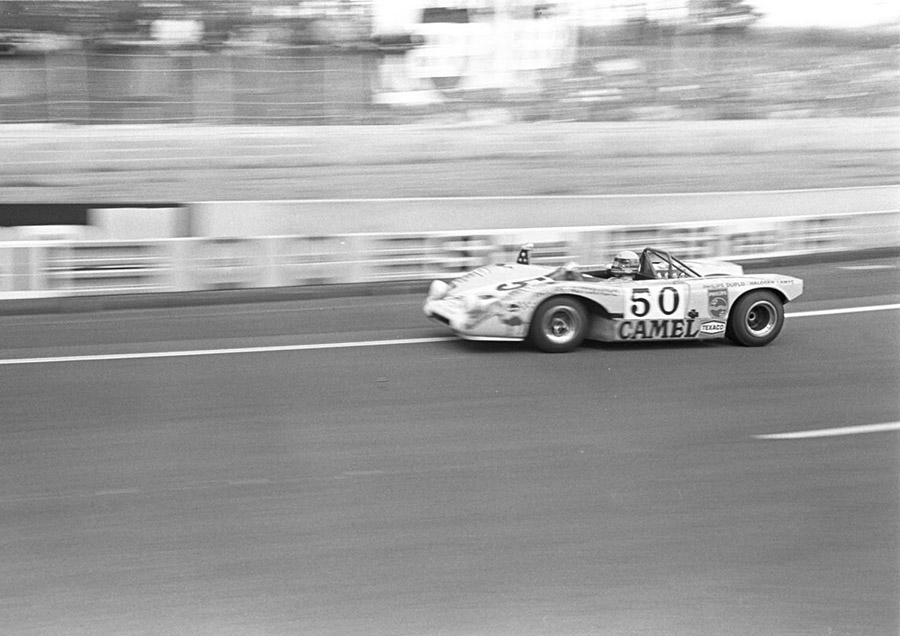
A year later, Edwards switched to sports car racing with a Lola T600. Guy shared this prototype with the Spaniard Emilio de Villota, achieving World Championship victories at Brands Hatch and Enna-Pergusa. In 1985, he competed in the 24 Hours of Le Mans alongside David Hobbs and Jo Gartner. The trio shared a Porsche 956B entered by John Fitzpatrick Racing, securing an impressive fourth-place finish. Before finally hanging up his helmet, Edwards competed in the British Touring Car Championship (BTCC) driving a Ford Sierra RS500, with which he achieved several second- and third-place finishes. Guy Edwards retired from racing for good at the end of 1989, subsequently devoting himself entirely to securing sponsorship—a venture in which he was highly successful. A severe stroke later left him with serious disabilities.
As if the likeable Brit hadn’t already endured enough drama in his life, his son Sean tragically lost his life during a track day in Australia while coaching another driver. At the time, his son was enjoying great success in the Porsche Supercup and the Porsche Carrera Cup Germany.
Guy Edwards passed away on June 1st at the age of 83 in Connemara, Ireland.