Maserati’s MC12, The GT Legend

By Marcel Hundscheid / Speed-O-Graphica
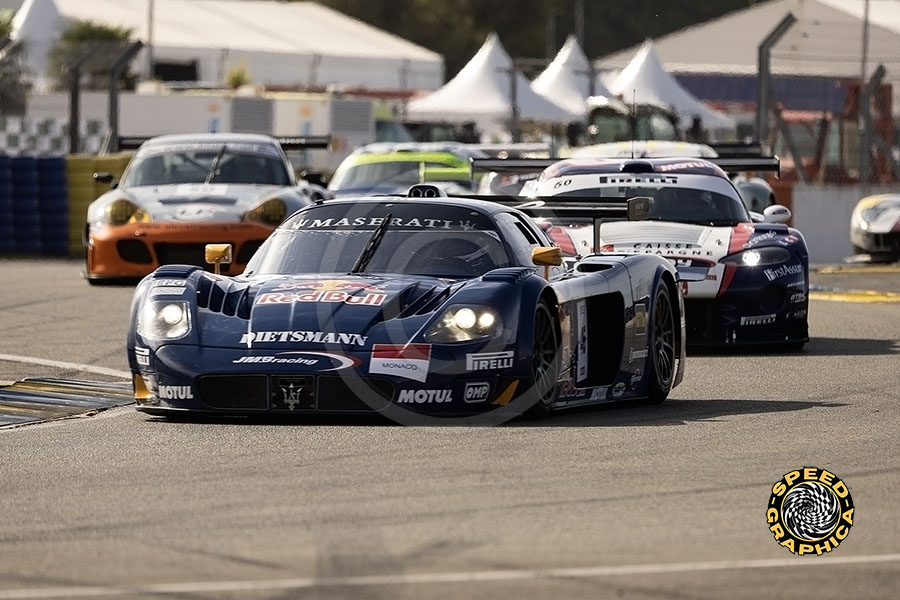
When discussing iconic GT1 race cars, there is undoubtedly one that simply cannot be overlooked. The Maserati MC12 has gone down in history as one of the most dominant sports cars in the history of GT racing.
The Italian manufacturer can look back on a glorious history, yet its very last success dated back to 1958, when Juan Manuel Fangio claimed his fifth Formula 1 world title in a Maserati 250F. Two years later, Stirling Moss and Dan Gurney triumphed in a Maserati Tipo 61 Birdcage at the Nürburgring 1000 km.
Subsequently, an eerie silence descended on Maserati for three decades as the brand struggled to survive under various owners. The tide only turned after Fiat and later Ferrari provided the necessary financial support.
The GT1 class in the FIA GT Championship was initially utilized for a brief period by Porsche and Mercedes. The machines unveiled at the time—often unrecognizable race cars presented as GT versions—prompted the FIA to intervene.
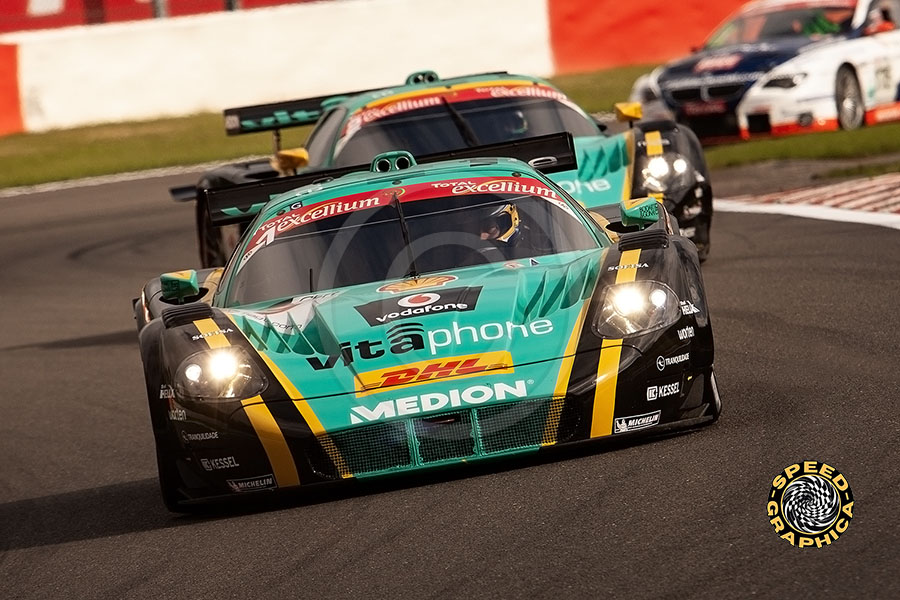
Michael Bartels driving the winning MC12 GT1 at the Spa 24 Hours back in 2008.
For Maserati, the GT1 championship provided the ideal platform for further exploration, and the Italian brand subsequently began developing the MC12 in 2002. The carbon-composite monocoque from the Ferrari Enzo served as the foundation for the MC12. Maserati opted for a mid-mounted 5,998 cc V12 engine, mated to a six-speed semi-automatic transmission.
The only reason Maserati had a road-going version of the MC12 developed was to meet homologation requirements. Andrea Bertolini was recruited as a test driver, marking the start of an intensive testing period. On occasion, he was joined by Michael Schumacher, who at the time was well on his way to winning his fifth consecutive Formula 1 world title for Ferrari.
Maserati introduced the MC12 for both road and track in 2004, with the MC12 GT1 making its debut at the Imola 500 km in September of that year. The FIA had granted permission for the MC12 GT1 to compete in three races on a non-homologated basis.
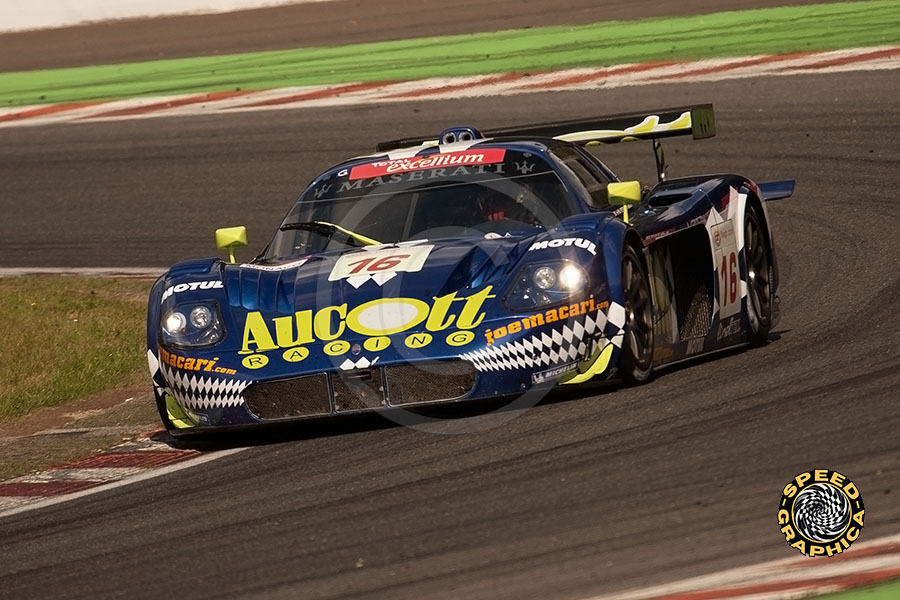
JMB Racing entered this MC12 GT1 for the Spa 24 Hours from 2007 finishing in 7th place.
However, the FIA had already laid down the law before homologation even came into the picture. For instance, the width of the rear wing had to be reduced, while the restrictor openings also had to be adjustable. As if that were not enough, it also had to be possible to add more ballast.
Based on the data obtained, the FIA was then set to make a decision regarding the homologation application in October of that year. The FIA’s final decision to homologate the MC12 GT1 came well in time for the season finale in Zhuhai, which was won by Mika Salo and Andrea Bertolini. The potential of Maserati’s new weapon was further underscored by the second-place finish achieved by Johnny Herbert and Fabrizio de Simone.
What followed was unprecedented. The MC12 GT1 dominated and wiped the floor with the competition. Maserati won just about everything there was to win. In the first full season, the team championship went to the Vitaphone Racing Team. Michael Bartels’ team repeated the feat in 2006.
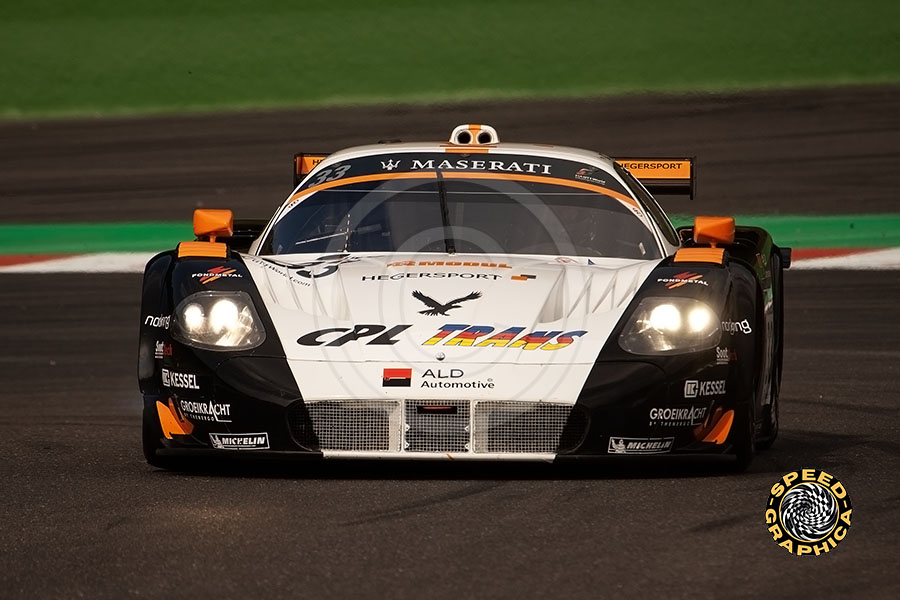
One of two Triple H Team Hegersport MC12 GT1’s at the Belgian round of the FIA GT1 championship in 2010 at Spa.
However, the one thing the Italian manufacturer had not yet succeeded in achieving was the drivers’ championship. Thanks to Ferrari, Gabriele Gardel clinched the 2005 championship in the GT2 class. In 2006, Vitaphone Racing Team was so dominant that it secured the drivers’ championship in addition to the teams’ championship; Michael Bartels shared the title that year with Andrea Bertolini.
Vitaphone Racing proved to be the team to beat, as the team championship went to Bartels Motor & Sport GmbH—the team’s actual operating entity—in 2007, 2008, and 2009 as well. However, Michael Bartels ran his team under the name of the title sponsor, Vitaphone GmbH. Thomas Biagi was crowned drivers’ champion in 2007. In 2008 and 2009, the title went to Bartels again, although he shared it with Andrea Bertolini during those years.
Another remarkable feat was the participation of the MC12 GT1 in the 24 Hours of Spa, a race it won no fewer than three times. In 2005, Michael Bartels, Timo Scheider, and Eric van de Poele triumphed for Vitaphone Racing. The following year, victory went to the Vitaphone Racing Team, with Michael Bartels, Eric van de Poele, and Andrea Bertolini. The Vitaphone Racing Team secured its third win in the Ardennes in 2008 with Michael Bartels, Andrea Bertolini, Stéphane Sarrazin, and Eric van de Poele.
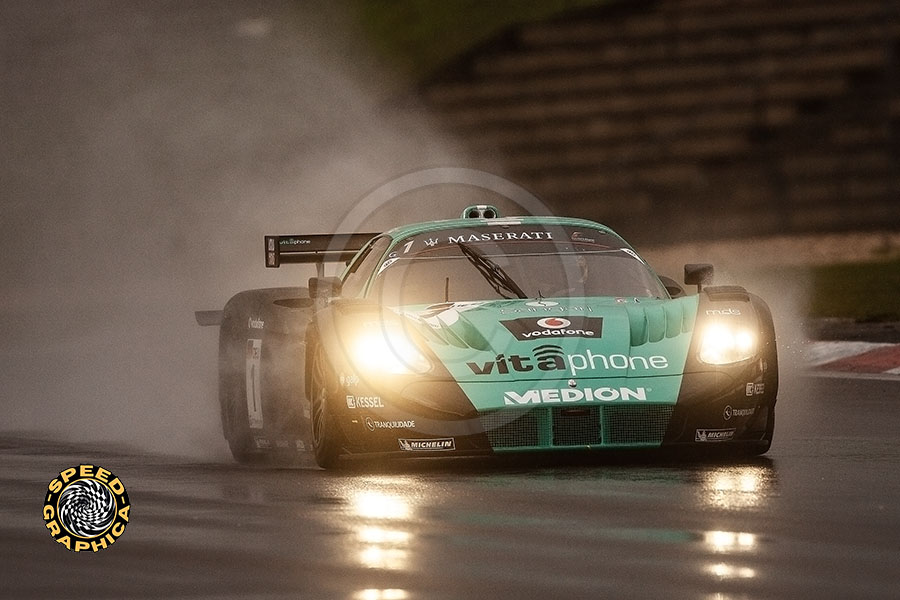
Michael Bartels captured during a very wet FIA GT1 race at the Nürburgring back in 2010.
It was frustrating for Maserati that the MC12 GT1 was permitted to compete in the 24 Hours of Spa, yet the ACO blocked its participation in the world’s most important 24-hour race, the 24 Hours of Le Mans. Throughout the time the MC12 GT1 competed in the FIA GT Championship and—following its 2004 homologation—was allowed to take part in the 24 Hours of Spa, the ACO stood in the way.
Permission was refused primarily because the ACO deemed the bodywork far too long. However, the tide seemed to turn in early 2010 when the FIA decided to split the GT1 and GT2 classes into two separate series. The ACO subsequently agreed to allow cars competing in the new FIA GT1 World Championship to participate in the 24 Hours of Le Mans. Nevertheless, not a single MC12 GT1 appeared on the starting grid at Le Mans in 2010.
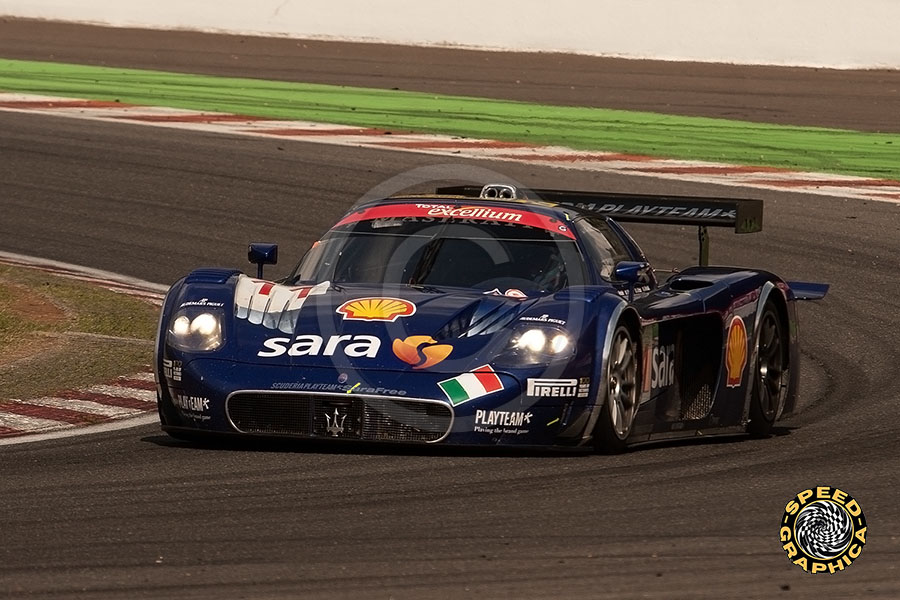
Scuderia Playteam Sarafee’s MC12 GT1 finished in 5th place at the Spa 24 Hours from 2007.
The MC12 GT1 will undoubtedly go down in history as one of the most dominant GT cars ever. When compared to other GTs of that era—such as the Ferrari 550, Aston Martin BR9, and Corvette C6.R—it is immediately apparent that the Italian Trident was by far the superior machine. In 2010, the final year this remarkable car competed, Vitaphone once again secured the world title for teams, while Michael Bartels and Andrea Bertolini claimed the drivers’ world championship for the fourth time.
Only ten MC12 GT1s were built by Maserati. Fortunately, the car has been preserved in running condition for posterity. While the MC12 GT1 was consistently barred from competing at La Sarthe during its active racing career, it now frequently appears at the Le Mans Classic and other Peter Auto events.
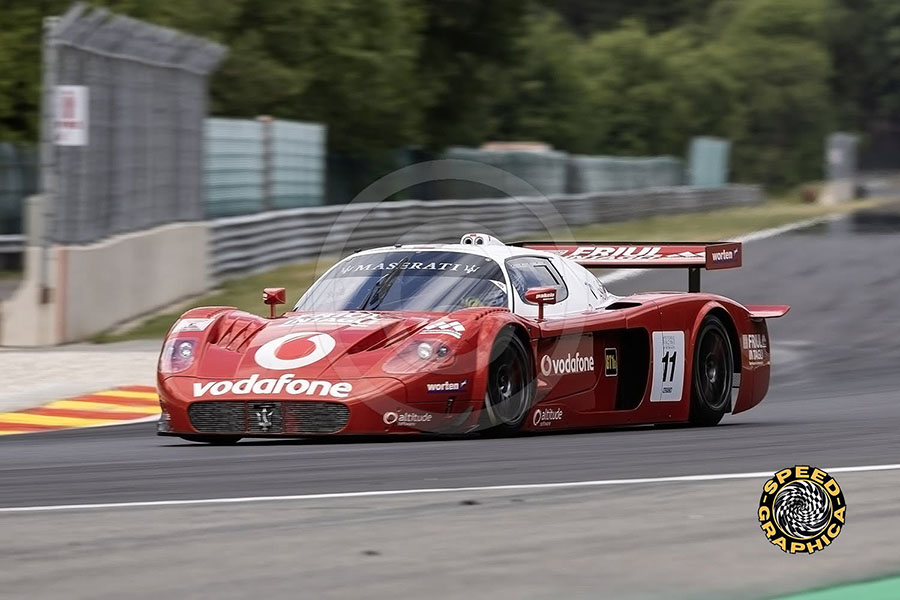
This MC12 GT1 raced in the Italian GT Championship and is seen here at the Spa Classic from 2025.
