Formula 3: The Origins, 1971-1984 Part 7

By Marcel Hundscheid / Speed-O-Graphica
In our seventh part of our retrospective about the origins of Formula 3 1971-1984 and the major F3-constructors, we take a closer look at Lola.
Eric Broadley founded Lola Cars Limited in 1958, initially focusing on the construction of small, front-engined sports cars. During the 1960s, the company also began developing single-seater racing cars, including Formula Junior and Formula 3 models.
Lola’s first Formula 3 car, the T53, made its appearance in 1964; only one was ever built. In reality, it was a Lola Mk5A Formula Junior car that had been converted into an F3 racing machine to comply with the Formula 3 regulations of the time. The T53 was used by the Midlang Racing Partnership and was powered by a BMC engine.
Lola introduced the dual-purpose T60 in 1965, which could be used in both Formula 2 and Formula 3. The design did not prove to be a success, although a victory was recorded at Monza in 1966.
Lola decided to field the T62—which appeared in 1966—in both Formula 2 and Formula 3. Ultimately however, it was decided not to build a variant for Formula 3. Due to the success of the T70 sports car, interest in Formula 3 gradually faded away over the remainder of the 1960s.
Lola announced the T240 in 1971 which could be used in Formula 2, Formula 3, and Formula B. However only one chassis was built for Formula 2. No cars were ever constructed for either Formula 3 or Formula B. In 1972, the T242 was announced—essentially an update to the T240.
The 1975 T350 was Lola’s first Formula 3 design since the T60 of 1965. Although the initial plan was to field two cars, only one chassis was ultimately built. This car was entered into races in South Africa, England, and Monaco but it failed to reach the finish line in any of them.
Lola introduced the T470 in 1976, a model with which the British manufacturer also failed to make any significant impact. The T470 was based on the chassis of the T450, a design that had been used in Formula 2. Patrick Bardinon raced the T470 on several occasions, though he managed a top-ten finish only once.
The 1977 T570 represented another attempt by Lola to gain a foothold in the world of Formula 3. At the time, manufacturers such as Chevron, March and Ralt dominated the various F3 championships. Lola brought on former F1 driver Ian Ashley as a test driver; however, this move yielded little success, as his best result across just eight races was a seventh-place finish at Cadwell Park.
In late 1977, newcomer Nigel Mansell secured a fourth-place finish for Lola during a round of the BRDC Vandervell British Formula 3 Championship at Cadwell Park. All in all, the T570 was yet another design with which Lola failed to achieve any success.
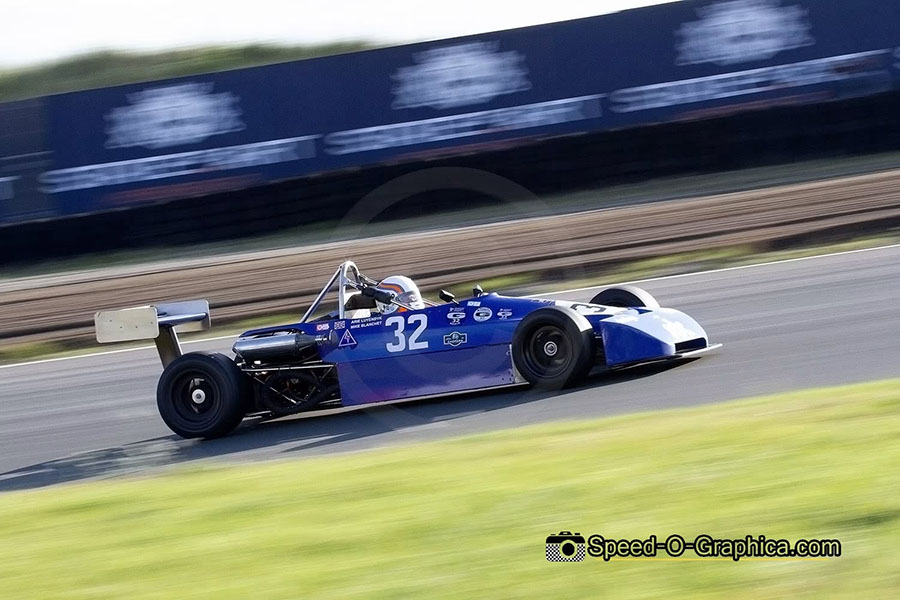
The T570 was succeeded by the T670 in 1978—essentially a new design, though one that incorporated lessons learned from the negative experiences with the earlier T570. Although the car—driven by Mike Blanchet and Arie Luyendijk—managed to secure a number of top-10 finishes for Lola, this design also failed to deliver the top-tier results that had been hoped for.
The T770, introduced by Lola in 1979, was based on the T550 model used in Formula 2. Only four of these cars were built.
Lola’s final Formula 3 design from the period between 1971 and 1984 was the 1983 T870. Although Lola stated that the car was race-ready following a test program, the design never actually appeared at the start of a race.
In our next installment covering the key Formula 3 constructors from the 1971–1984 period, we will take a look at Lotus and March.